
Local airports saw passenger counts slide again during the third quarter, dashing any hopes of a summer rebound.
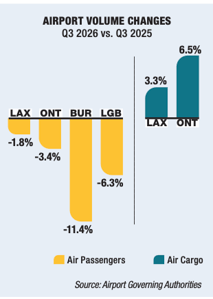
The four airports serving Los Angeles County – Los Angeles International, Ontario International, Hollywood Burbank and Long Beach – collectively saw 23.5 million passengers go through their gates during the third quarter, a 2.8% drop compared to the same quarter last year, according to figures released by each of the airports’ governing authorities.
Soaring fuel costs brought about by the latest conflict in the Persian Gulf prompted airlines to slash flights and sharply raise ticket prices. As a result, fewer travelers took to the skies, leading to dips in passengers at all four airports.
In an interview with the Business Journal this past spring, John Ackerman, chief executive of Los Angeles World Airports, the city agency that runs LAX, summed up the dashed hopes at local airports.
“We were just starting to see some green shoots of added flights in January and February and then, ‘boom!’ the Iran war happened and jet fuel prices went through the roof,” he said.
“Given these headwinds, airlines have been guiding capacity down for the rest of the year.”
But the picture for air cargo was much brighter as all four airports saw gains in air car- go tonnage during the third quarter. Cumulatively, air cargo tonnage jumped 4% compared to the same quarter last year.
Burbank sees sharpest passenger drop
 Unlike the last couple of years when smaller regional airports were booming and LAX was the laggard, this year, the situation is reversed.
Passenger counts at LAX have tended to stabilize, while tallies at the other three airports have fallen off.
Hollywood Burbank Airport saw the biggest percentage drop in passengers, with an 11% plunge during the third quarter compared to the same quarter last year.
The story at Hollywood Burbank Airport has been the continuing impact of the exit of two air carriers within the last year. In the runup to its complete shutdown on May 2, Dania Beach, Florida-based Spirit Airlines Inc., sold hundreds of planes and cut scores of routes across the country, including at Hollywood Burbank. And Houston-based Avelo Airlines Inc. announced last year it was closing its West Coast hub at Hollywood Burbank, exiting the airport entirely.
Earlier this year, airport officials expected the picture to have brightened by now. Five airlines – Seattle-based Alaska Airlines Inc., Las Vegas-based Allegiant Air, Cottonwood, Utah-based Breeze Airways, Dallas-based Southwest Airlines Co. and New York-based JetBlue Airways Corp. – had previously announced a total of 11 added flight routes. And some of the additional flights have already begun, including seasonal Alaska Airlines service to Honolulu, Hawaii.
But these gains have been more than offset by the flight cuts resulting from higher fuel prices. Now, airport officials, under the new leadership of Steven Baker, are hoping for a surge in passengers eager to use the brand new $1.3 billion, 355,000-square-foot terminal that opened last month.
Long Beach struggles
Like Burbank, Long Beach Airport has struggled this year with repeated year-over-year drops in passenger counts. But at Long Beach, the focus has been on Southwest Airlines Co., which is by far the dominant player with more than 85% of total passengers and flights. The Dallas-based carrier has cut routes across the country. It’s also recovering from controversial moves it made last year to end its two free checked bags and open seating policies, two of the factors that had led to its loyal following.
In May, Alaska Airlines announced it was resuming service at Long Beach in September with flights to Seattle. While airport officials hoped that would boost traffic at the airport, these new flights were more than offset by other flight cutbacks as Southwest and other airlines have sought to combat rising aviation fuel costs.
As a result, passenger traffic at Long Beach fell 6.3% during the third quarter.
Ontario’s star fades a bit
For roughly five years coming out of the COVID-19 pandemic lockdown of 2020, Ontario International Airport has been the star performer among local airports. At one point during that stretch, the Inland Empire airport logged 54 consecutive months of year-over-year gains in passengers – largely the result of an aggressive marketing campaign for both airline flights and local passengers.
But during the third quarter, Ontario lost its star performer standing as passenger counts fell 3.4% from the same quarter last year. For the first nine months of the year, passenger traffic was essentially flat, with a very slight decline of 0.07%.
“Airlines continue to adjust capacity in response to higher operating costs, and ONT is not immune to those industry pressures,” said Atif Elkadi, chief executive of the Ontario International Airport Authority.
For most of this year, there had been one bright spot for the airport: sharp growth in international passengers as a bunch of new international flights started service late last year.
Because the airport had so few international passengers prior to last year, adding a few daily or even weekly flights made a big difference, as reflected in double-digit growth rates. But that leveled off during the third quarter, settling at just 0.77% when compared to the same quarter last year. In raw terms, there were only 1,200 more international passengers this third quarter compared to last year.
Elkadi, though, sees these sluggish numbers as more of a blip on the radar in the airport’s long-term growth following its return to local control 10 years ago. (For 49 years up until 2016, Los Angeles World Airports had administered the Ontario airport.)
“The strength of our market and the progress we’ve made over the past decade give us every reason to remain confident,” Elkadi said. “As we approach 10 years of local control, our focus remains on expanding air service, enhancing the passenger experience and positioning ONT for continued growth.”
LAX as best performer
Strange as it may seem, LAX turned in the best performance during the third quarter in terms of passengers going through its gates. The passenger tally fell only 1.8% – the smallest drop among the four airports.
For years coming out of the pandemic lockdown, LAX was the laggard among the four airports. After the initial post-lockdown bump in 2021 and 2022, growth stalled and by late 2024 turned negative. But that downturn may be coming to an end. In September, growth turned positive again, though only by 0.15%.
One reason for this is simple: after so many months of declines, a bottom may have been reached. Ackerman, in his comments earlier this year, did indicate that “flat performance was a fair forecast for the rest of this year.” Now, that may actually be happening.
But even this slight growth could stall out again – thanks in part to the technology meltdown earlier this month that led to a 4.5-hour grounding of all commercial flights nationwide and disrupted travel patterns for several days after. However, the degree of impact from the grounding won’t be known until the November passenger figures come out in late December.
Air cargo posts solid gains
The air cargo picture at the four airports serving Los Angeles County was much brighter than the passenger side.
During the third quarter, nearly 845,000 metric tons of air cargo flowed through the four airports, up 4.1% compared to last year.
The main focus for air cargo is at LAX and Ontario International, which together comprise nearly 98% of all air cargo at the four airports.
LAX posted a gain of 3.3% during the third quarter compared to last year, while Ontario International posted a gain of 6.5%. For the first nine months of this year, cargo tonnage at Ontario International was up 16.5%
One reason for the gains across the board was the uncertainty over tariffs last year that served to depress the 2025 air cargo totals. While those concerns have not disappeared – witness the blowup in trade relations between the United States and Canada a couple of months back – the overall picture has returned to a more nor- mal status.
At Ontario International, another key factor is its proximity to the huge warehouse hubs in the Inland Empire. The airport authority’s announcement of the September and nine-month totals noted that the airport has outperformed the cumulative 9% growth rate of air cargo hubs worldwide so far in 2026.
The post Airports See Turbulence in Q3 appeared first on Los Angeles Business Journal.


