Are You Paying for More Claude AI Capability Than Your Business Actually Needs?
ISHIR helps enterprises select, integrate, and optimize Claude models for secure, cost-efficient AI workflows that deliver measurable business value.

Claude AI Model Selection Guide for 2027: How to Balance Performance, Speed, Token Costs, and Enterprise AI ROI
Anthropic just became one of the world’s most valuable publicly traded companies. Its Claude models are getting more capable, its enterprise ecosystem is expanding, and businesses are moving from AI experiments to production deployments.
But there is a problem nobody can solve simply by buying access to the most powerful model.
Your enterprise doesn’t need the smartest AI model for every task. It needs the right intelligence at the right cost.
Why use an advanced reasoning model to classify 10,000 customer support tickets? Why rely on a lightweight model to evaluate a complex financial acquisition? And why should your engineering team spend thousands of dollars on AI tokens when a different model architecture could deliver comparable business results for substantially less?
These are not minor technical decisions. They determine whether your AI investment becomes a competitive advantage or another expensive technology initiative.
With Claude Haiku 5.5, Sonnet 5.5, Opus 5.5, Fable 5.2, and restricted-access Mythos 5.2, businesses have more options than ever.
The challenge is knowing when to use each one.
This guide explains how enterprise decision makers should approach Claude AI model selection, compare API pricing, evaluate performance, and build a cost-efficient AI architecture that scales.
On November 19, 2026, Anthropic’s shares closed their first day of public trading at $97.17, approximately 17% above the IPO price of $83.
According to Reuters, the company reached approximately $1.77 trillion in fully diluted valuation at the close, after briefly reaching a $2 trillion market value during trading.
The IPO reflects extraordinary investor expectations surrounding AI adoption and the growing commercial importance of Claude.
But a trillion-dollar valuation does not automatically translate into profitable AI adoption for enterprises.
For a CEO, CTO, or CIO, the more important questions are:
These questions matter because AI costs multiply with usage, workflow complexity, and the number of model calls required to complete a task.
The companies that succeed with Claude will not necessarily be the ones using the most powerful models. They will be the ones designing the most effective AI systems.
Anthropic’s latest models serve different performance and workload requirements.
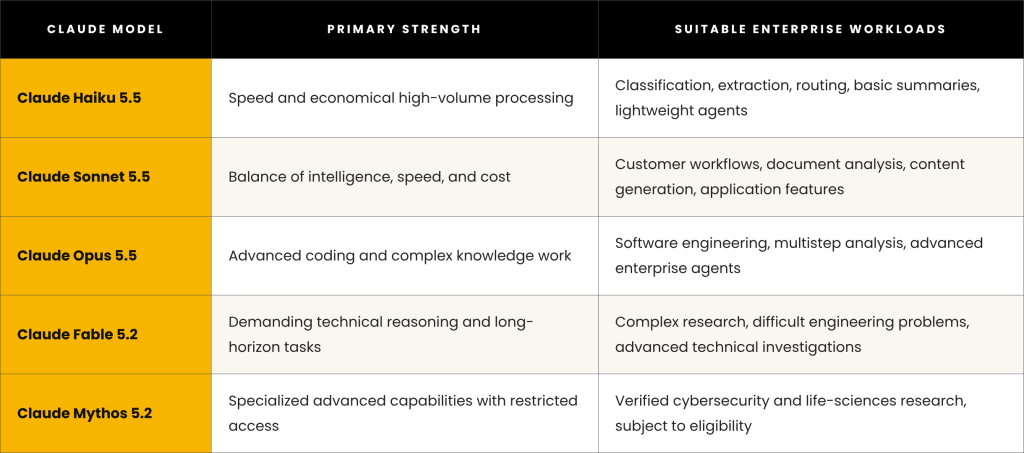
Anthropic recommends Opus 5.5 as a starting point for many general workloads, with Fable 5.2 for particularly demanding problems.
However, that is a model capability recommendation, not a mandate to deploy Opus everywhere. For a production system processing millions of routine transactions, Sonnet or Haiku may provide a more economical architecture if they meet the required quality threshold.
Another important distinction: Fable 5.2 and Mythos 5.2 share the same underlying model. Fable includes additional safeguards, while Mythos is available only to organizations verified through Anthropic’s applicable programs. Mythos should not be treated as a generally available premium upgrade.
Pricing is where enterprise AI strategy becomes a financial decision.
Anthropic charges for API usage based primarily on input tokens and output tokens, subject to model-specific pricing and applicable features.
As of November 20, 2026, published standard API rates include:
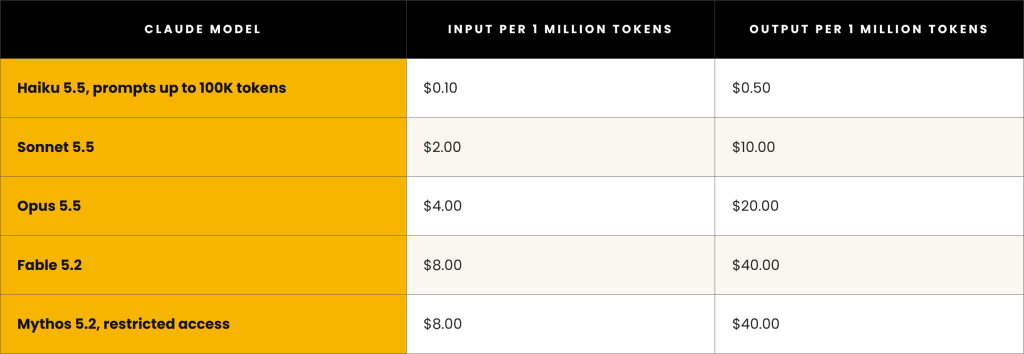
Haiku 5.5 has a higher pricing tier for prompts exceeding 100,000 tokens. Additional charges or pricing adjustments may apply for caching, fast modes, long-context features, cloud providers, and other usage conditions.
These are model API prices, not complete enterprise implementation costs.
Assume a business application processes 100,000 requests per month.
Each request uses:
This produces 200 million input tokens and 50 million output tokens per month.
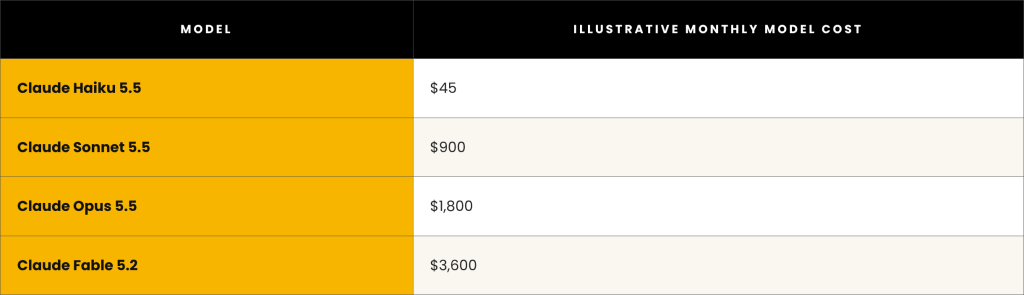
The same volume and token assumptions produce dramatically different API costs.
A company using Fable for this workload would spend 80 times the direct model cost of Haiku.
But there is an important catch.
These figures do not measure whether the models complete the work equally well.
If Haiku fails frequently and requires human correction or repeated escalation, the actual cost gap can shrink quickly.
Conversely, if Haiku achieves the required quality, paying for Fable adds cost without necessarily adding value.
The correct financial question is:
What does each model cost per successfully completed business task?
That is the metric enterprises should optimize.
Token pricing provides a starting point. It does not capture everything required to operate an enterprise AI system.
A single customer request may require several API calls.
An agent may retrieve information, inspect documents, call tools, reason through results, retry a failed operation, and generate a final response.
A workflow that appears to involve one AI interaction may actually generate five, ten, or more model calls.
Claude’s current flagship models support context windows of up to one million tokens.
That does not mean every request should include massive documents or full conversation histories.
Long prompts can increase costs, affect response time, and introduce irrelevant information.
Good context engineering matters as much as model capability.
Advanced reasoning and long-form responses can generate substantial output.
Since output tokens generally cost more than input tokens, unnecessarily verbose responses can increase costs.
Enterprises should configure outputs based on the actual business requirement.
A classification workflow may need a short structured response, not a detailed explanation.
A cheaper model that produces unreliable results can create hidden labor costs.
For example, an AI system may save an employee five minutes initially but create fifteen minutes of review work when its output is wrong.
That is not productivity improvement.
Production AI requires more than model access.
Businesses may need identity management, permissions, logging, audit trails, data controls, retrieval infrastructure, testing, monitoring, and incident response.
These costs should be included when evaluating enterprise AI ROI.
A successful enterprise AI architecture should evaluate four dimensions before committing to a model.
Do not choose an AI model because it performs well on a general benchmark.
Test it against your own business workflows.
A financial services company should evaluate the model on representative financial documents, exceptions, policy requirements, and calculation tasks.
A software development company should evaluate real repository changes, bug fixes, tests, and architecture questions.
Measure:
For high-stakes work, passing a benchmark is not equivalent to authorization to make autonomous decisions.
Response time matters differently across use cases.
A customer service assistant may need to respond in seconds.
An overnight financial report can tolerate a longer processing window.
A complex engineering agent may reasonably take substantially longer if it completes valuable work accurately.
Measure both median and 95th-percentile latency under realistic traffic conditions.
A model that performs well during a demonstration may behave differently under concurrent enterprise workloads.
Model capability should be evaluated against task complexity.
A routing system does not require the same reasoning capability as an application modernization agent.
Start by classifying work into three categories:
Simple tasks: Extraction, classification, routing, formatting, basic summaries.
Moderate tasks: Document interpretation, knowledge retrieval, business writing, multistep routine workflows.
Complex tasks: Technical architecture, deep analysis, difficult software engineering, long-horizon agentic investigations.
These categories are useful starting points, not rigid rules.
Real-world evaluation should determine whether each model is sufficient.
Enterprise leaders should calculate more than API spend.
A practical formula is:
Total AI workflow cost = Model API costs + Infrastructure + Integration + Monitoring + Human review + Rework + Operational maintenance
Then calculate:
Cost per successful task = Total workflow cost / Number of successfully completed tasks
This exposes why the lowest-priced model is not always the most economical option.
It also prevents teams from assuming that the most capable model automatically delivers the best return.
The traditional approach to AI deployment often looks like this:
A company chooses one model, connects it to a few applications, gives employees access, and expands usage over time.
That approach is simple to launch.
It is rarely the best architecture for a large organization.
Consider an enterprise that wants to automate customer support, document processing, business reporting, code review, and technical research.
Each workload has different requirements.
Using Fable everywhere could create unnecessary expense.
Using Haiku everywhere could introduce reliability problems.
A better approach is workload-based AI model routing.
Instead of routing every request to the same model, the application evaluates the type, complexity, risk, and required response time of each task.
A practical architecture could work as follows:
Step 1: Classify the incoming task.
Determine whether it involves simple extraction, routine business reasoning, complex engineering, or specialized research.
Step 2: Route to an appropriate model.
Use Haiku for low-complexity requests, Sonnet for moderate tasks, and Opus or Fable when the workload requires stronger reasoning.
Step 3: Validate the output.
Apply schema checks, business rules, automated evaluations, and human review where appropriate.
Step 4: Escalate when necessary.
If a model cannot complete a task within the required quality threshold, escalate to a stronger model or a human reviewer.
Step 5: Track the results.
Monitor quality, completion rates, response times, token usage, and cost per successful outcome.
This architecture gives enterprises more control over performance and spending.
It also creates a path for adapting when Anthropic introduces newer models or changes its pricing.
Business challenge: Staff spend substantial time processing administrative documents and routing routine requests.
Potential architecture:
Business objective: Reduce administrative processing time without compromising accuracy, privacy, or oversight.
Healthcare organizations must independently assess applicable HIPAA requirements, contractual obligations, data handling, and access controls before deploying any AI workflow involving protected health information.
Business challenge: Analysts manually evaluate large volumes of financial documents, contracts, and supporting evidence.
Potential architecture:
Business objective: Improve processing efficiency while preserving traceability, accuracy, and accountability.
The model should support financial analysis, not replace the controls governing financial decisions.
Business challenge: An aging application has accumulated technical debt, undocumented dependencies, and security concerns.
Potential architecture:
Business objective: Accelerate modernization while managing regression risks and preserving maintainability.
Every code change should still pass appropriate automated tests, security checks, and engineering review before deployment.
A newer or more capable model may perform better on complex tasks without offering meaningful benefits for simple workflows.
Select based on measured business performance.
The least expensive model may create substantial downstream costs if it frequently fails.
Measure successful outcomes and correction costs.
A model that performs well on 50 test prompts may struggle when thousands of users interact with the application simultaneously.
Test concurrency, latency, rate limits, and failures.
Complex models are valuable when complexity exists.
Applying them to every task can waste budget.
A wrong internal meeting summary and a wrong financial calculation do not have equivalent consequences.
Model selection and validation should reflect business risk.
Unnecessary conversation history, duplicated documents, and uncontrolled agent loops increase expenditure.
Build explicit context management, output limits, and usage controls.
Hardcoding one model into every workflow makes future optimization and migration more difficult.
Use configurable routing, version management, evaluations, and monitoring so the architecture can evolve.
Enterprises can improve Claude economics through several engineering practices.
Use smaller models for bounded tasks. Classification, routing, and extraction often provide opportunities to use Haiku instead of a more expensive model.
Implement intelligent model routing. Escalate to Opus or Fable only when task complexity and evaluation results justify it.
Use prompt caching where appropriate. Repeated system instructions and common reference material may benefit from caching, subject to Anthropic’s caching requirements and pricing.
Reduce unnecessary context. Retrieve only relevant business information instead of sending entire repositories, databases, or document collections.
Control agent loops. Set limits on tool calls, retries, execution time, and token consumption.
Evaluate output quality continuously. Monitor both successful outcomes and failure patterns as prompts, data, and models change.
Set budget thresholds. Track usage by department, application, tenant, workflow, and model.
Most importantly, avoid cost optimization that reduces reliability below the organization’s acceptable threshold.
A system that costs 50% less but fails twice as often may not save the business anything.
Choosing a Claude model is only one part of enterprise AI adoption.
The harder work is integrating AI into the systems, data, permissions, workflows, and operational processes the business already depends on.
ISHIR is a member of the Claude Partner Network, with Anthropic-certified engineering professionals supporting Claude-powered AI implementation.
Through its Claude API implementation and AI architecture capabilities, ISHIR helps organizations move beyond generic AI experimentation toward production-ready systems designed around measurable business requirements.
The objective is not to deploy the most expensive Claude model. It is to build an AI architecture that produces dependable business results at a sustainable cost.
ISHIR helps enterprises select, integrate, and optimize Claude models for secure, cost-efficient AI workflows that deliver measurable business value.
There is no single best Claude model for every enterprise application. Haiku 5.5 is suitable for many high-volume, latency-sensitive tasks; Sonnet 5.5 balances capability, speed, and cost; Opus 5.5 supports demanding coding and knowledge work; and Fable 5.2 targets particularly difficult technical reasoning. Enterprises should select models using workload-specific evaluations.
Claude Opus is positioned for more demanding reasoning, complex coding, and longer-running agentic work. Claude Sonnet offers a balance of intelligence, speed, and lower API costs. Sonnet may be more economical for routine enterprise applications, while Opus can be justified for difficult tasks.
Claude Haiku can be effective for classification, extraction, routing, and other bounded business tasks. It may not be sufficient for workflows requiring complex interpretation or extended reasoning. Businesses should test its accuracy on representative data before production deployment.
Claude Fable 5.2 is designed for demanding technical reasoning, advanced coding, complex research, and long-horizon agentic workflows. It is most appropriate when the benefits of its advanced capabilities justify the higher API cost.
Fable 5.2 and Mythos 5.2 share an underlying model, but Fable includes additional safeguards that enable broader availability. Mythos access is restricted to organizations verified through applicable Anthropic programs, including certain cybersecurity and life-sciences use cases.
For eligible standard workloads using prompts of up to 100,000 tokens, Claude Haiku 5.5 has the lowest published per-token rates among the models compared here. Its actual cost advantage depends on task completion rates, usage patterns, and applicable pricing tiers.
Businesses can reduce costs through workload-based model routing, prompt caching, controlled context sizes, efficient retrieval, output limits, agent execution controls, and continuous evaluation of cost per successful task.
Multiple models can be beneficial when workloads differ significantly in complexity, latency requirements, and acceptable cost. However, the additional routing and operational complexity must also be justified. Smaller implementations may benefit from starting with one model and expanding as evidence supports it.
Yes. Claude can be integrated with existing systems through APIs, middleware, retrieval architectures, and controlled tool interfaces. Successful implementation requires appropriate access management, data handling, testing, and workflow design.
ISHIR helps organizations evaluate Claude workloads, design API integration architectures, implement AI agents, optimize token consumption, and establish production-focused security and monitoring practices. Its Claude Partner Network membership and Anthropic-certified engineering professionals support this implementation work.
Anthropic’s historic IPO and the introduction of Fable 5.2 and Mythos 5.2 show how quickly advanced AI capabilities are progressing.
But the enterprise challenge is becoming more demanding, not less.
Companies now have access to models capable of handling increasingly sophisticated work. That does not eliminate the need for architecture, evaluation, governance, and cost management.
The post Claude Opus, Sonnet, Haiku, Fable, or Mythos: Which AI Model Actually Fits Your Enterprise Workload? appeared first on ISHIR | Custom AI Software Development Dallas Fort-Worth Texas.


