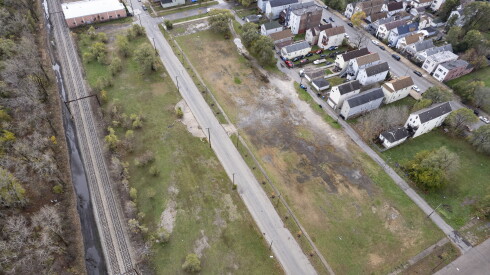
A group of Chicago leaders recently came up with some ideas for repurposing the estimated 50,000 vacant lots scattered across Cook County: an Englewood tree ribbon, community farms and gardens and new housing near South Chicago’s quantum computing campus.
The proposals were part of a series of workshops, or so-called charrettes, where participants such as developers, funders, artists and more discussed possible solutions for the thousands of vacant lots in the county. Their ideas were presented at the Chicago Architecture Center last month at an event called “The Future is on the Map.”
The charrettes hosted 175 leaders from around the Chicago area at the Obama Presidential Center in September to discuss three areas that the vacant lots could support: arts, culture and open space; housing; and economic development. Attendees included Chicago Transit Authority Acting President Nora Leerhsen and Michael Fassnacht, Clayco's chief growth officer and former CEO of World Business Chicago.
Ghian Foreman, president and CEO of the Emerald South Economic Development Collaborative and an attendee, said they came up with fresh ideas that included a range of perspectives.
“It was Chicago. It wasn't just the same people that I'm used to being in the room with saying the same things that we always say to each other,” Foreman said. “You had a cross-section of people across the city of Chicago, and everyone was able to put in a little bit of their expertise — like a potluck dinner. Everybody brought these ideas to the table.”
Also among the ideas was something that’s been floated in Chicago throughout the years: a redevelopment authority.
There are hundreds of redevelopment authorities across the U.S. At one point, there were 400 in California. The public agencies operate at either the local, county or state level and are tasked with acquiring and priming land for redevelopment as a way to reduce community blight. But no redevelopment authorities exist in Illinois, according to Cook County Commissioner Bridget Gainer.
“If you look around, whether it's the city, the county, or the state, there is not one single entity that is responsible for producing housing at speed, at affordability and geographically distributed in communities all over,” Gainer said.
The Cook County Land Bank Authority was formed by the Cook County Board in 2013 to redevelop the large number of vacant properties in the county, from residential to commercial and industrial buildings. While the land bank has helped create roughly 3,000 homes, Gainer said it has a narrow scope for how it addresses vacancies and build new homes. As the state carves out agencies like the Northern Illinois Transit Authority, Gainer sees an opportunity to do something similar with housing.
Now, Gainer wants to lead the path to creating a redevelopment authority.
“The affordability of housing — it keeps people here. It grows our population. It allows people to have a dignified existence,” Gainer, who helped found the land bank, said. “It really behooves us to go out of our way to make it work.”
The Chicago region is just one place that has renewed interest in establishing redevelopment authorities. But interest in them is far and wide, said Justin Marlowe, director of the Center for Municipal Finance at the University of Chicago’s Harris School of Public Policy. He said it stems, in part, from the federal government pulling back funding for the U.S. Department of Housing and Urban Development.
“We typically thought about these sorts of redevelopment activities as having a lot of federal involvement, which is not to say that they don't or that they won't going forward,” Marlowe said. “But I think there's lots of questions right now about what kind of partner the federal government is going to be when it comes to these sorts of urban development issues. And so you have lots of places now saying if we're going to do this, we probably do need to muster the support to do it locally and regionally.”
Chicago owns 10,000 vacant lots and has taken several stabs at reducing that figure, including launching the Missing Middle Infill Housing program in 2024. The program, which sells vacant land to developers for $1, has created more than 300 new homes on the South and West sides, where vacant lots are the most prolific.
A redevelopment authority could advance the city's work and the land bank's efforts by putting tax entitlement clearance, debt writing capacity and development authority under one entity, Gainer said.
Emerald South, the Obama Foundation’s economic development partner, aims to attract and coordinate investment in neighborhoods such as Washington Park, Woodlawn and South Shore, with a focus on increasing local ownership and prosperity. Its $50 million Terra Firma program is designed to beautify, maintain and activate vacant land.
Foreman said a redevelopment authority could help Emerald South flip those vacant lots by cutting through red tape, such as coordinating with different agencies and levels of authority from the Chicago Department of Planning and Development to the Department of Water Management, Cook County Land Bank and Chicago Public Schools.
“One of our biggest challenges is we have so many different steps you have to go through and different sets of rules and competing priorities,” Foreman said. “How do we set these things up where we can be as efficient as possible? What would it look like to empower a group that could work across the [government agencies] to be able to get us what we're all looking for, which is the most efficient and effective way of improving our communities equally across the city, across the county, across the state? Ultimately, what we're looking for is improvement in the communities.”
Gainer said a redevelopment authority that mirrors NITA, serving a broad region, would make the most sense.
What’s next is a more focused planning process that Gainer wants to keep collaborative, similar to the charrettes.
As the region thinks about what’s next, Marlowe said it’s important to learn from other municipalities while taking a local approach — including how such an agency would be funded and how it’d track success.
“One of the things that we know from other places is these [agencies] work really well when they have very clear metrics for what success looks like, whether that's dollars of reinvestment, numbers of units of housing built, numbers of vacant lots cleared,” Marlowe said. “When you go to the regional level, the needs are going to be very different from one place to the next, and therefore, the metrics probably need to be different. So, how do [you] deal with that trade off? How do you deal with that complexity? I think it can be dealt with. It's just that you have to be very thoughtful about it from the beginning.”